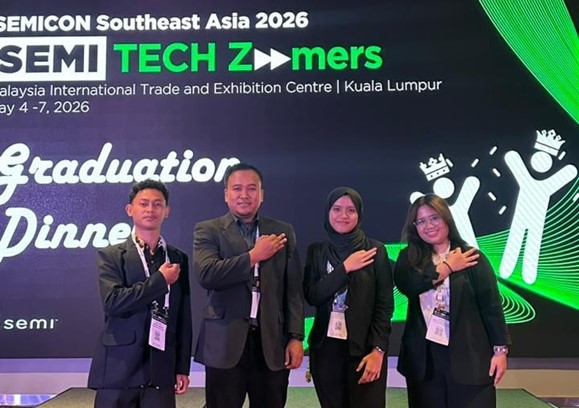
Kuala Lumpur, Malaysia – Three students from the Department of Electrical and Informatics Engineering (DTEDI), Vocational College, Universitas Gadjah Mada (UGM), had the opportunity to participate in the Semicon Southeast Asia (SEA) Zoomers Bootcamp 2026, held from May 4–7, 2026, in Kuala Lumpur, Malaysia. This international program brought together students from various countries, including Singapore, Malaysia, Vietnam, Australia, and Indonesia, to enhance their knowledge and skills in the semiconductor industry.
Semicon Southeast Asia Zoomers Bootcamp 2026 was designed as an intensive program combining technical training, group discussions, industry case studies, and company visits. Through this program, participants gained comprehensive insights into semiconductor technology, current industry challenges, and career opportunities in one of the most strategic sectors driving global digital transformation.
Throughout the bootcamp, participants were mentored directly by professionals from leading semiconductor companies, including GlobalFoundries, Micron Technology, Tokyo Electron Limited (TEL), Melexis, SilTerra, and SSMC. These mentors presented participants with real-world statement challenges, encouraging them to develop innovative solutions using technical, analytical, and collaborative approaches.
The mentoring sessions were highly interactive, allowing students to discuss both technical and business aspects of the semiconductor industry. Participants also gained valuable perspectives on emerging technologies such as artificial intelligence (AI), electric vehicles (EVs), the Internet of Things (IoT), and intelligent electronic systems, all of which rely heavily on advanced semiconductor technologies.
In addition to the training sessions, participants joined site visits to several key institutions and companies in Malaysia, including onsemi and MIMOS Berhad, Malaysia’s national applied research and development center specializing in microelectronics and semiconductor technologies. During these visits, students observed firsthand the processes of research, design, testing, and semiconductor manufacturing before the technologies are integrated into modern electronic products.
These industrial visits provided invaluable experience, enabling participants to connect classroom knowledge with real-world applications. Students also gained a deeper understanding of industrial standards, automation systems, quality control, and the global challenges of semiconductor supply chains.
On the final day of the program, all participants presented their proposed solutions through a poster exhibition at the Malaysia International Trade and Exhibition Centre (MITEC), Kuala Lumpur. The presentations were evaluated by judges and representatives from participating companies, who provided feedback on the innovation, feasibility, and technical depth of each team’s work.
The participation of DTEDI SV UGM students in this international bootcamp reflects the department’s commitment to supporting students in developing globally competitive competencies. Beyond expanding international networks, the program strengthened participants’ communication, critical thinking, problem-solving, and cross-cultural collaboration skills.
Through this experience, the students are expected to inspire their peers at DTEDI to continue broadening their horizons and actively contribute to the advancement of high-tech industries, particularly in the semiconductor sector, which plays a crucial role in shaping the future of technology.

Related Sustainable Development Goals (SDGs)
This activity supports several Sustainable Development Goals (SDGs), including:
SDG 4 – Quality Education: by enhancing students’ competencies through international industry-based learning experiences.
SDG 9 – Industry, Innovation and Infrastructure: by strengthening human resources in advanced semiconductor technologies.
SDG 17 – Partnerships for the Goals: by fostering collaboration among universities, global industries, and international research institutions.